Media Theories
The theories I wanted to focus on for my media service are minimal effects model and knowledge gap. The minimal effects model is when a media consumer has selective exposure and selective retention of information they have read or seen through various media devices or systems. And the content they consume is content that reinforces the personal views and attitudes the individual already holds, researchers of minimal effects model “[…] argue that mass media reinforces existing behaviors and attitudes rather than change them” (Campbell et all, p. 527).
Knowledge gap theory is the idea that information is not distributed equally between the high socioeconomic population and lower socioeconomic population, and that knowledge within these different groups vary because of possible educational differences (Oxford Bibliographies, 2019).
How do these theories relate to my media service
The media service I’m creating is a mobile application that is a news aggregator, “a program that collects related items of content and displays them or links to them” (“Aggregator”, 2019). The minimal effects model theory would apply to my media service because the application will be challenging the consumers preferred content with opposing material. In turn challenging the minimal effects theory model.
Knowledge gap applies to my media service because my application would include a subsection with tips and links that teach consumers how to tell the difference between reliable sources and misinformation.
Why these theories over others
I decided on minimal effects theory over the cultivation effect theory because the cultivation effect theory states that “[…] heavy exposure to media causes individuals to develop an illusionary perception of reality based on the most repetitive and consistent messages of a particular medium […] commonly [applying] to the analysis of television” (University of Minnesota, 2019) and I think that with the purpose of my media service is to break the cycle of consumers only consuming media to solidify their already existing behaviors and attitudes.
Furthermore, I decided on knowledge gap theory because I believe that the more knowledge an individual has, the better they are able to make informed decisions that are important to them. With the advancement and accessibility of today’s technology, it has been easier than ever to spread misinformation. Having easily accessible, non-text heavy content for consumers in my application that informs them of what to look for in their news sources I’m hoping this would alter the knowledge gap.
Media Scholar
My media scholar was supposed to be Anu Hastings, a communications and outreach specialist for the Department of Communication at the UWB campus, I was hoping to secure an interview with her but was unable to. I had selected her as my primary source because her background consists of content strategy, analytical thinking, and data-driven marketing. Her expertise in those areas would have bee beneficial in knowing if a media service like mine would have the chance of working in our society, and how plausible an idea like this would be.
How will media service work?
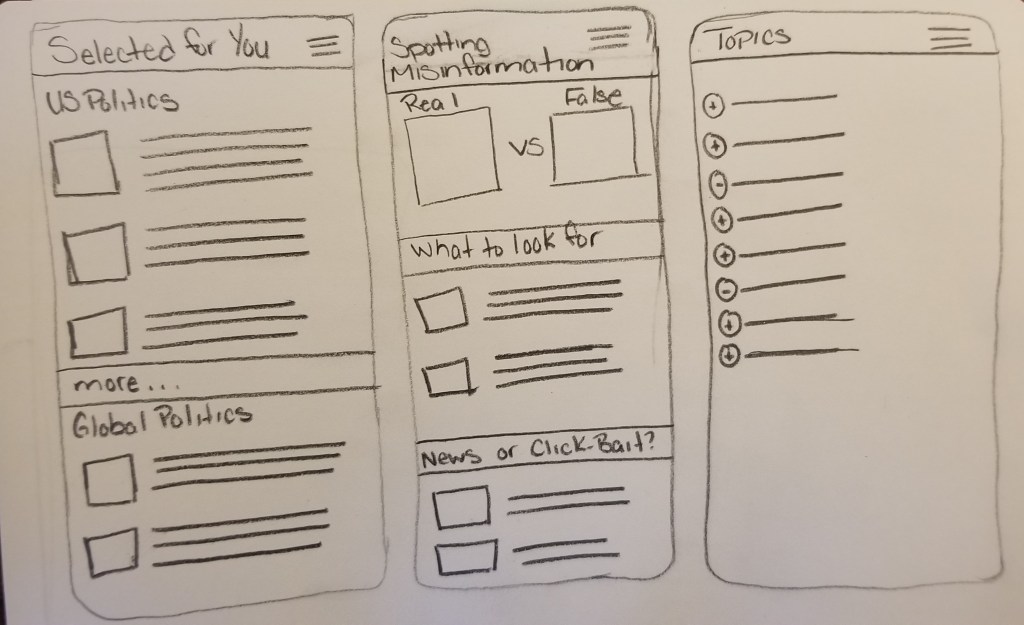
The consumer will download the application onto their smartphone. Since the application will be a news aggregator, the user will have to go into the application and select topics of interest locally, nationally, or globally. With the ability to select certain news outlets you’d want included in the topic feeds. These variables will help determine what to display for the consumer.
Depending on which links the user selects, the application will also find links to content with opposing views from a myriad of reliable sources in the selected medium, for example, if I finished watching a video on why hate speech doesn’t exist, another video would pop up into my feed about the rise of hate speech. With a one-to-one ratio of content.
Before the topic selection section there will a page with tips on how to spot misinformation that will help consumers obtain the right information to help them determine if an article is click-bait misinformation or real.
Additionally, Consumers will also have the ability to share the media content on various social-media platforms such as Twitter, Instagram, and Facebook.
Benefits and advantages over other media services
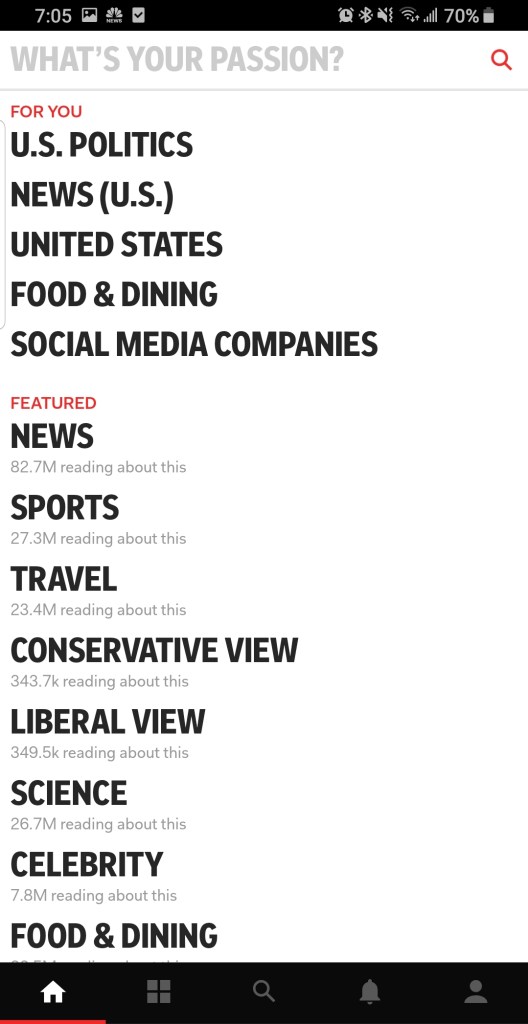
Current existing media services similar to my application are the FlipBoard and HuffPost mobile applications, where the consumer has the ability to select the category of news they want to consume. However, from my experience with applications like FlipBoard, consumers get reinforced information related to what they are clicking on and consuming, much like how social media links, the more you click on an article or video, the more similar articles and videos will appear in your social media feed. So what advantages and benefits does my media service have over existing services? My application would generate links to articles, videos, and social media content that would challenge the content the consumer clicks on. There will be areas for real news and opinion articles and a section with tips and articles on how to spot misinformation.
Unlike click-bait articles, which with the help of algorithms, help generate more related content. Click bait articles promote the minimal effects model behavior and this application would challenge that.

Why now?
I think now is a good time for a service like because there has been an increase in misinformation lately. Consumers don’t have too much of a say in what content automatically gets delivered to them, much of the content that gets relayed back to them is generated by algorithms promoting the minimal effect model. By having a news aggregator that generates similar content with opposing view points and sources, this will give the consumer varied information while allowing them to make well-informed choices.
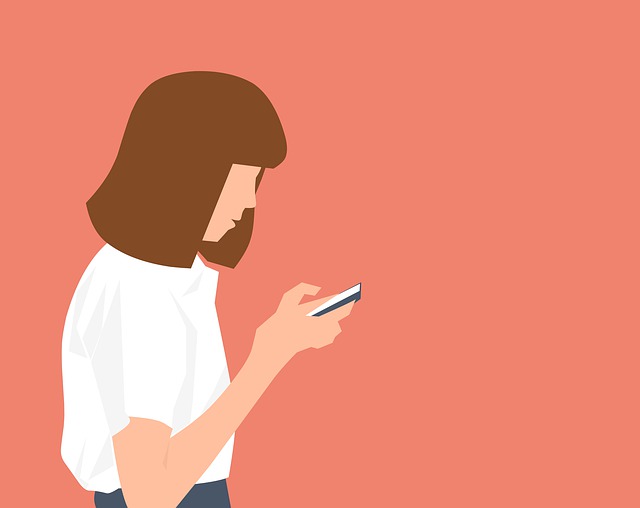
According to a recent 2019 study by Pew Research Center, 57% of Americans get their news from mobile devices, doubling since 2013 when it was only 21% (Pew Research Center, 2019). And a recent Guardian article stating that people are passive about the news information they receive, often looking for images and less text to get their information (The Guardian, 2019). If media consumers can have easy and automated access to multiple view points, their media consumption may be less passive.
Will it change the world?
I don’t think the application will change the world. I hope it will get people to slow down and process news differently instead of passively through their social media accounts which tend to use algorithms to reinforce users content choices. Additionally, I do think it would get people talking, possibly paving the way for someone to create similar content.
References
Campbell, R., Martin, C.R., Fabos, B. (2014). Media & Culture: Mass Communication in a Digital Age. Boston, MA. Bedford/St. Martin’s
Knowledge Gap. (2019). In Oxford Bibliographies. Retrieved from https://www.oxfordbibliographies.com/view/document/obo-9780199756841/obo-9780199756841-0078.xml
Aggregator. (2019). In Oxford Online Dictionary. Retrieved from https://www.oxfordlearnersdictionaries.com/us/definition/english/aggregator#aggregator_inflg_1
University of Minnesota. (2019). 2.2 Media Effects Theories. Retrieved from https://open.lib.umn.edu/mediaandculture/chapter/2-2-media-effects-theories/
Walker, M. (2019, November 19). Americans favor mobile devices over desktops and laptops for getting news. Retrieved from https://www.pewresearch.org/fact-tank/2019/11/19/americans-favor-mobile-devices-over-desktops-and-laptops-for-getting-news/
Waterson, J. (2019, December 5). Uncovered: Reality of how smartphones turned election news into chaos. Retrieved from https://www.theguardian.com/politics/2019/dec/05/uncovered-reality-of-how-smartphones-turned-election-news-into-chaos
 Communications 203 Final Project